- Jul 9
The 9 Skills That Turn AI Anxiety Into Confidence
Why you don’t need to keep up with AI—and how to take control instead
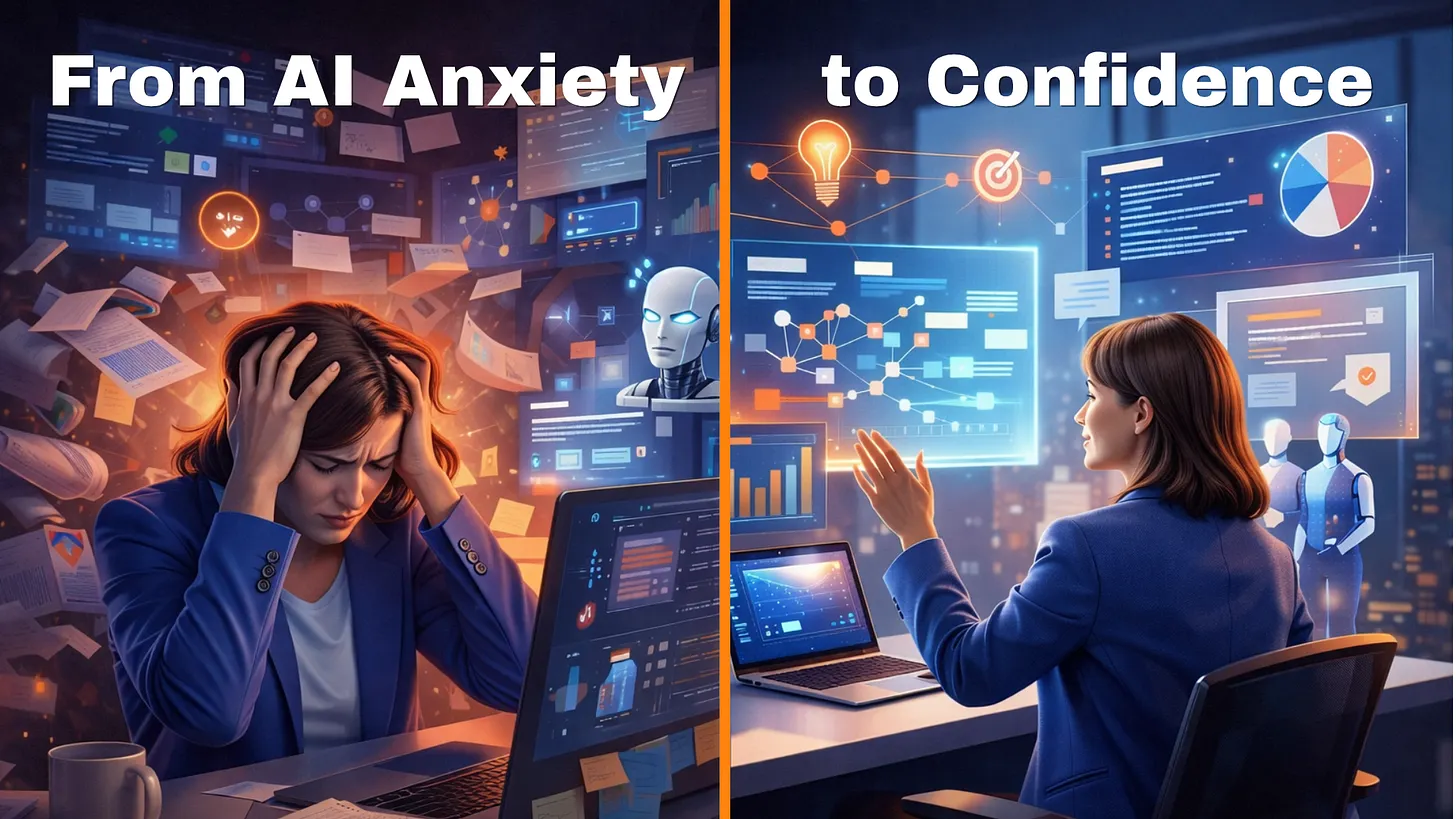
If you’ve felt overwhelmed by AI lately, you’re not alone. Most people aren’t struggling because AI is too complex. They’re struggling because they don’t feel confident using it.
And when confidence drops… anxiety takes over.
Thanks for reading! Subscribe for free to receive new posts and support my work.
Last week, I listened to several bold AI evangelists confidently declare that Claude is superior to ChatGPT. They said it with certainty. Authority. Conviction.
But something felt off.
Not because they were entirely wrong—but because they were operating from such a small slice of what AI is actually capable of.
Most people today are using a fraction of what these tools can do. And still, they’re willing to plant a flag and say, “This is the best one.”
One of them even charges hundreds of dollars to train others—based on his experience, not on the full capability of the systems.
That’s where things start to break down.
Because the truth is simple: The “best” AI depends on what you need. And even that answer changes… quickly.
The Mistake We Keep Making
We don’t evaluate tools based on their full potential.
We evaluate them based on:
what we’ve experienced
what others are saying
what feels easiest right now
And over time, something subtle happens.
We stop asking what a tool can do… And we start defending what we already know.
That’s not a technology problem. That’s a confidence problem.
A $26 Million Lesson
Imagine you’re at the RM Sotheby’s auction during Monterey Car Week.
A Ferrari Daytona SP3 sells for $26 million. You buy it.
Your friend Bob buys a 2025 Corvette for $80,000.
A few days later, you’re both at a stoplight. Bob revs his engine. It sounds incredible. He knows a little about what his car can do.
Under normal conditions, you wouldn’t even think twice about the outcome.
But there’s a problem.

You only know 1% of your Ferrari’s capabilities.
You’ve figured out how to put it in neutral… and push it.
You haven’t learned how to start the engine.
The light turns green. Bob takes off.
And just like that, the conclusion is made: Corvettes must be better than Ferraris.
We’re Doing the Same Thing With AI
We argue about platforms. We compare features. We chase whatever tool feels “better” this week.
All while barely understanding what we’re actually using.
The issue isn’t whether Claude is better than ChatGPT. The issue is that we’re trying to pick a winner… Without ever learning how to drive the car.
Why This Feels So Overwhelming
Let’s be honest. There are too many options.
ChatGPT. Claude. Copilot. Gemini. Perplexity. Grok.
Open-source models. Automation tools. AI agents. Swarms.
You could spend weeks just trying to figure out where to start. And even if you do…The answer might change next month. Or next week. Or tomorrow.
This is where the anxiety comes from.
Not from AI itself—but from the feeling that you’re falling behind, choosing the wrong tool, or missing something everyone else seems to understand.
We’ve Lived This Before
This isn’t new.
We’ve seen this pattern with video formats.
Betamax versus VHS. LaserDisc. DVD. Blu-ray. Streaming.
Every time, people felt pressure to choose the “right” platform.
Every time, that choice eventually became irrelevant.
But the anxiety in the moment? Very real.
Here’s the Truth No One Wants to Admit
You will never keep up with AI. Not completely. The pace is too fast.
In the late 1800s, knowledge doubled every 100 years. By the late 1900s, it doubled every 25 years. Today, it may double every few hours.
Soon, it could be measured in minutes.
You can’t win that race.
But You Don’t Need To
Because the goal was never to keep up with AI. The goal is to direct it.
And the fastest way to reduce anxiety…is to increase competence.
The Shift That Changes Everything
At some point, I stopped asking: “What’s the best AI?”
And I started asking: “What do I need to bring so AI actually works well?”
That’s when things got simpler. And more powerful.
Because when your competence increases, something else happens. You gain confidence. And confidence has a way of eliminating anxiety.
The 9 Skills That Build Competence
AI is powerful. But it depends on human input to produce meaningful results. There are nine skills that allow you to direct AI instead of being directed by it.
What You Bring
Purpose — why this matters
Vision — what success looks like
Discernment — what matters and what to do next
Empathetic Listening — hearing what’s said and unsaid, and responding in a way that makes people feel understood
Intuition — recognizing direction without complete data
Wisdom — applying experience and values over time
How You Work With AI
Communication — clarify, simplify, amplify
Connection — engage, relate, build
Collaboration — align, act, achieve
Why This Works
AI doesn’t need more prompts. It needs better human input.
If your thinking is unclear, AI wanders.
If your vision is vague, AI scatters.
If your discernment is weak, AI overwhelms you with options.
But when you build competence in these nine areas, something shifts.
You stop reacting to AI.
You start directing it.
From Anxiety to Confidence
Most people are trying to keep up. That’s why they feel anxious.
But anxiety doesn’t come from the technology. It comes from a lack of confidence in how to use it.
And confidence doesn’t come from testing more tools. It comes from building competence.
The more you develop these nine skills, the more capable you become. The more capable you become, the more confident you feel.
And when confidence rises…anxiety disappears.
One Final Thought
AI can generate the work. But only you can give it meaning.
And when you learn how to do that consistently… You won’t feel behind anymore.
You’ll feel in control.
Copyright ©2026 by CJ Powers